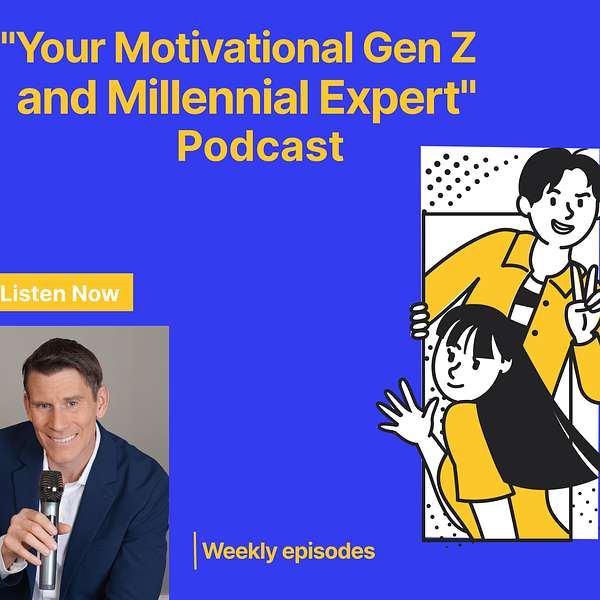
Your Motivational Gen Z and Millennial Expert-Your host: Dr. Jason Wiggins
I focus on the motivational aspects with a high emphasize on motivating Gen Z and Millennials (GEN X will also find great value) and the employers who employ them for continuous improvement. This podcast focuses on motivating Gen Z and Millennials to empower to overcome obstacles within our everyday lived experiences. I have a passion for educating, speaking and guiding Gen Z and Millennials to achieve great things. Gen Z and Millennials have experienced so much in a short amount of time as the world continue to move faster. Self-Awareness and belief in our abilities provide a strong foundation for health, happiness and prosperity in a world that offers continuous challenges.
This is a motivational series for Gen Z and Millennials and those who aspire to do great things, while interested in understanding these two great generations and how we can aspire to be better because of the value of motivating through life experiences.
Life is hard, but when we challenge others or ourselves to be successful, then the world demonstrates the value of those who put in the effort. My hope is that each listener will find value and then share that value with others. I am a change leader that is passionate about life transformations and taking our passion and motivation to the next level. YOU CAN DO IT! Remembers Dreams without Goals are just Dreams.
Your Motivational Gen Z and Millennial Expert-Your host: Dr. Jason Wiggins
The Success Pivot: Work-Life Balance-Peace Over Hustle (Episode 178)
Burnout isn’t a badge of honor, and the “dream job” doesn’t deserve your identity. Gen Z, and Millennials are Burned out and need a road map. We unpack why the hustle lost its promise and map five shifts that make life feel whole again: swap achievement traps for fulfillment, break job enmeshment, set firm boundaries in an always-on world, face financial realities with clear-eyed strategy, and treat mental health as the new flex. Along the way, Dr. Wiggins shares personal lessons from chasing a title into a 70-hour week and explains how peace, time autonomy, and rest turn into long-term performance.
We explore how younger workers measure success by freedom—taking a midday walk without guilt, turning off notifications after hours, and choosing projects aligned with values. If constant pings and late-night emails define your days, you’ll get practical ways to reclaim focus: hard stops at 5 p.m., batch communications, and a shutdown ritual that signals your brain to switch off. We also get real about money. With housing and costs rising, the grind no longer buys what it used to, so we talk portable skills, smarter upskilling, and avoiding prestige traps that drain cash and energy.
Finally, we reframe mental health from a private fix to a public standard. Therapy replaces power lunches, eight hours of sleep beats four, and calm becomes a competitive edge. When someone asks what’s new, talk about the hike you took or the book that changed your week—because your worth isn’t your work. If you’re ready to build a life you don’t need a vacation from, press play, take a breath, and try one boundary today. If this resonated, subscribe, share with a friend, and leave a review telling us the boundary you’re committing to this week.
Hello friends, welcome to your motivational Gen Z and Millennial Expert Podcast. I am your host. My name is Dr. Jason Wiggins, and it is amazing to be here today with you. Today, I wanted to get real about something. I've been seeing everywhere lately. For a long time, we're told that success meant the grind, working until you were burnt out just to prove you're valuable. But millennials and Gen Z are officially changing the rules. We're trading the hustle for mental health and realizing that a job title isn't worth losing ourselves. Today I'm breaking down why the hustle is dead. How can we actually build a life we don't need a vacation from? Let's dive in. I want to really focus over the peace over hustle. And when you look at the peace over hustle, what does that mean? It means where do you not work yourself to an absolute death? Well, there are five key points that are going to demonstrate why you can successfully beat the hustle and not sit there trying to chase your parents' dreams. Your parents' dreams were to own a home, to own two titles to their car, to have annual vacations, to look like they're better than their neighbors. But that is just not what America is now moving towards. It's the five key points that will demonstrate the difference between what was expected from our Gen X and baby boomers to what now Gen Z and millennials are demanding in the workforce. Older generations often defined success by external markers. As noted, the house, the title, the car. It is the achievement trap versus fulfillment. So ultimately, Gen Z and millennials are shifting inward. Success is now measured by time autonomy. Having the freedom to go for a walk, see your friends, and pursue a hobby without feeling guilty, about feeling the burn from your employer calling you at 5:30 at night after hours to ask you a question or get you prepared for the next day. And ultimately, you feel guilty. You feel like you're letting yourself down, your boss down, the team down. But that is where it's the achievement trap versus fulfillment. What fulfills you? Excites you to do what you want. What are your passions to fulfill? What do you want? And that's why we're looking for peace over the hustle. Gone are the days where you have to work two, three, four jobs. Yes, that is what it has been like for many decades now. Especially once Generation X saw their baby boomer parents working 6 a.m. to 6 p.m., they thought they needed to do it too. That is just not simply the truth. Number two out of the five key points when you look about peace over hustle. What brings you peace over the crazy chaotic times? Number two is the death of the dream job. What is your dream job? What have you always desired to be? To do sometimes your dream job can be your worst nightmare. I had what I thought was my dream job. I was a general manager for a large production plant for a large uniform company. I oversaw sales, service, production, everything between A to Z. And I thought I was going to love it. Everything I had done to that point was to get me to where I could be in my dream job. But then my dream job turned into 70 plus hours a week, a boss that was yelling, and it turned into an absolute nightmare. The point is the idea that a career should be your entire identity is fading. People say, Who are you? And what you would typically say in the past was, Oh, I work for so and so. No, I ask, who are you? Not who you worked for. And that's where times are shifting. Because when you lose your job, then what happens? Your identity fades. So job enmeshment is something I want to bring your attention to. Emeshment is where people are realizing that a job is a contract, not a family. This isn't about being lazy. I know that Gen Z and millennials are always seen as the lazy ones. They are the lazy generation. They don't want to put in the effort. But it's not about being lazy, it's about diversifying your identity. So if you lose your job, you don't lose yourself. Imagine all of these people in the workforce right now that are having difficulties of finding a job. They are struggling with their identities. Why? Because that's what has made them who they are today. They are what their last job was. So now the death of the dream job has got to move on. You need to find your passions, find something that intrigues you, that lights that fire under you and really pushes you in the direction you want to become. And now, as I dive into my 50s, I realize what's more important to me, my family, my friends, the ability for me to help others, to provide that platform and that direction to help young Gen Zs, young millennials, help those employers that want to understand them better. And so if you look at those first two key concepts, one was the achievement trap versus the fulfillment, second with the death of the dream job. And the third out of the five is the always on burnout paradox. Technology has made it impossible to leave the office. There was a time where your home phone was exactly that specific to a home phone. Meaning, once you were off work, if they couldn't get a hold of you at home, they couldn't get a hold of you. Doctors had pagers, and that's how you got a hold of them. So if there was an emergency, a doctor had a pager, they would call back, and that's where, and the reason why pagers existed. Pagers then moved to getting a hold of people from those that were young to those that were old, just to get in touch. And then we morphed into the cell phone. So the point is technology has now made it impossible to leave the office. You take your laptop home. You're always at the mercy of your cell phone. And what happens? You never get a break. People are getting calls at 5 a.m. to 9 p.m., depending who's working on what Eastern Standard Time versus Pacific Standard Time. So this takes a mental toll. Think of Slack, emails, LinkedIn notification. And that's why you have the quiet quitting, the hard stops. The 5 p.m. is a survival mechanism. Stopping at 5 p.m. is not a lack of ambition, it's a response to a world that never sleeps. You are at the mercy of your phone, your computer, and the digital age. The internet, the technology has now made it impossible for you to get away unless you set your boundaries. If you don't set your boundaries, what happens? You get ultimately burned out. You get burned out. The number four key point of the five key points that we're talking about when it comes to mental health and peace versus burnout is the financial realism. The hustle doesn't buy what it used to. Why? Because everything has got increasingly more expensive. The reality, you have to be transparent here. To be able to afford a house with a white picket fence, a three-bedroom, two-bath with two cars is gone. The death of the homeowner is practically gone for a lot of millennials and definitely for Gen Z. Because now they're having to do house sharing, they're having to work one or two, three jobs. So with the house and the cost of living feel out of reach? Despite working 60 hours a week, the incentive to the grind disappears. Why work yourself to death when you don't have an end goal? A reasonable, I can grab it, I can touch it, I can feel it, goal. That is now what has happened to millennials, Gen Z, thankfully for our parents, the Gen X and the baby boomers, they were able to get where they wanted to go because things weren't so far-fetched out of reach. Now, college graduates can't get jobs, they have debt. You need a master's degree with 10 years experience to get an entry-level job. This is true. Why? Because I look at resumes every day and I see the experience or lack thereof or overqualifications, and I'm trying to determine who is going to be the best to hire. And it has made it more difficult to hire because the competition is so fierce, even for an entry-level job. Now we've talked about so far the key points: the achievement trap versus fulfillment. The second one was the death of the dream job. Three was the always on burnout paradox. Four was financial realism. And five was mental health as a status symbol. Now, what does this mean? Therapy is the new power lunch. In the past, being busy was a flex. Now being regulated, rested, and present is the ultimate goal and gift. A person who isn't stressed out is the new version of making it. What do you mean? How are they making it? Because they understand the flexibility, the ability to understand what's important in their life and how they can move forward. We carry our offices in our pockets. We have the smartphone. That's why it's so important to set the boundaries. Remember the old days? I only slept four hours. Well, that was the old flex. The new flex, I got eight hours of sleep and went for a midday walk. So encourage yourself to stop wearing burnout as a badge of honor. The days of 6 a.m. to 6 p.m., five to six days a week are over. So the next time someone asks you, what's new? Try not to talk about work. Tell them about, hey, what book are you reading? Or what walk did you take? What hike did you take? Remember, your worth isn't your work. Let me repeat that. Your worth is not your work. It's very key that you understand that we are so much more than just where we work and the title of where we are. So for today's episode, I hope you take that burnout is not a good thing. I hope this gives you some permission to set the boundaries or close your laptop a little earlier tonight. If you enjoyed this deep dive into the realism of burnout and the lack of financial gains and chasing the Joneses to get where you want to go in life, then take these stories that you have in life about how much you worked and how much you missed and throw them to the side. Start finding ways for you to celebrate the small wins in your life and feel good about what you're doing. So again, I want to thank everybody and please tag your stories about life and how you've overcome the burnout stage. Your mental preparedness, your mental well-being is more important than working yourself to death. Take care of yourself. I want to thank you. Please continue to like, share with your friends and family, and please hit the subscribe button if you're watching our YouTube channel. And I thank you. Take care. This is Dr. Wiggins, your motivational Zen Z and Millennial Expert podcast. And I'll talk to you later. Bye bye.

Podcasts we love
Check out these other fine podcasts recommended by us, not an algorithm.
