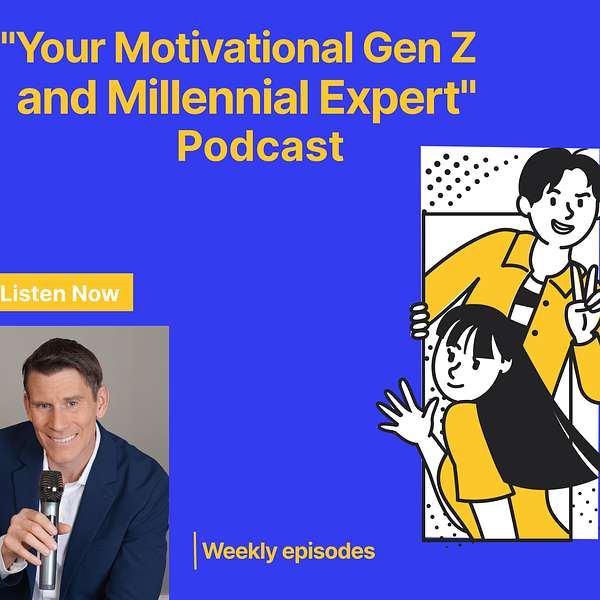
Your Motivational Gen Z and Millennial Expert-Your host: Dr. Jason Wiggins
I focus on the motivational aspects with a high emphasize on motivating Gen Z and Millennials (GEN X will also find great value) and the employers who employ them for continuous improvement. This podcast focuses on motivating Gen Z and Millennials to empower to overcome obstacles within our everyday lived experiences. I have a passion for educating, speaking and guiding Gen Z and Millennials to achieve great things. Gen Z and Millennials have experienced so much in a short amount of time as the world continue to move faster. Self-Awareness and belief in our abilities provide a strong foundation for health, happiness and prosperity in a world that offers continuous challenges.
This is a motivational series for Gen Z and Millennials and those who aspire to do great things, while interested in understanding these two great generations and how we can aspire to be better because of the value of motivating through life experiences.
Life is hard, but when we challenge others or ourselves to be successful, then the world demonstrates the value of those who put in the effort. My hope is that each listener will find value and then share that value with others. I am a change leader that is passionate about life transformations and taking our passion and motivation to the next level. YOU CAN DO IT! Remembers Dreams without Goals are just Dreams.
Your Motivational Gen Z and Millennial Expert-Your host: Dr. Jason Wiggins
Human Connection, Not Annual Reviews: Leading Gen Z And Millennials (Episode 176)
The workplace is being rebuilt in real time by people who won’t settle for vague orders, stale tech, or once-a-year reviews. We dive into what Gen Z and Millennials actually want from leadership—clear reasons, modern tools, and real care—and why those expectations unlock better performance for everyone on the team.
We start by separating birth years from lived experience, then map the cultural and tech shifts that shaped today’s workforce. From there, we show how to trade a “boss” mindset for a partner approach that turns hierarchy into collaboration. Reverse mentoring becomes a practical bridge: younger teammates set the pace with new software and workflow design, while experienced colleagues bring context and critical judgment. That exchange lowers friction, speeds adoption, and builds mutual respect.
Feedback is our throughline. Annual reviews arrive too late; micro feedback and quick check-ins make goals visible and growth continuous. We share the praise-plus-path formula for useful coaching and stress the power of follow-through when you can’t grant a request. Belonging matters as much as policy—having a best friend at work raises retention—so we highlight simple ways to create connection without performative perks. And we address the tech signal: obsolete systems push digital natives away, while thoughtful upgrades paired with a clear why keep people engaged and learning.
By the end, you’ll have a simple playbook: communicate with clarity, provide actionable feedback, modernize your tools, and sketch career roadmaps that actually move. Care is the new currency of work, and when leaders invest in it, Gen Z and Millennials respond with energy, ideas, and loyalty. If this resonated, tap follow, share it with a manager who needs it, and leave a review with one practice you’ll try this week.
Hello, friends. Welcome to your video podcast. I am your host. My name is Dr. Jason Wiggins, and I am your Gen Z and Millennial Expert. It is great to be here today. Normally we do a podcast that's only audio. We are now going mainstream. We are going to now be live on video as well. So it is great to be here today. I was at a recent conference where I had a chance to speak about Gen Z and millennials in the workplace. How to ultimately attract, retain, motivate, and lead this great generation. One of the things that I learned throughout the speech was the audience just was absorbing knowledge. Because the reality is, is that Gen Z and millennials are, by most definite way of putting it, they are rechanging, reshaping the workforce. They have now decided that they are no longer going to put up with the norms. I like to use the phrase, they're not going to listen to the boss ask, hey, I need you to jump. And they're not going to respond with how high. They're going to respond with why? How is it good for me? How is it good for the organization? Is there a reason I need to do it? What's the dialogue at the end that's going to help me? The reality is you have to be transparent and communicate with this generation. This generation is the most savvy, the most intelligent, and they know what they want. When you look at Gen Z and Millennials, they have something in common. They don't put up the BS. Gen X started it. Gen X started some of that work and life balance. They realized that they didn't want to work like their baby boomer parents. They wanted something different. So then after that, we had the millennials. As noted, the millennials reshaped the workforce. They wanted work-life balance. They wanted transparency. They wanted all the different new fun and games. Talk about Google. Talk about all the different ways of trying to attract and retain Generation Z and millennials. We have just hit the iceberg. So what do employers want to know? Employers want to know how do I motivate and retain these two workforces? Yes, I know that they've reshaped the workforce. I'm fully aware of that. But what do we do to keep them with us? We can't just have annual reviews. You have to have continuous feedback, dialogue, and really demonstrate that you care about the employee. Yes, you just heard it right here. I said you have to care about your employees. Think about the old days of the pension. The way employers showed that they cared about their baby boomers and maybe to some degree Generation X employees was because they had the pension plan. So when you retired, not only did you have Social Security, you also had the pension. But that's gone. The pension programs are gone. We still have the 4Ks. But a lot of companies don't actually match the four. So what we've seen now is self-reliance. And that is what Gen Z and millennials are good at. They're good at self-reliance. They're good at adjusting on the fly. They have no problems doing that. As long as you're transparent, you're sincere, you're clear, you're excuse me, you have clarity, these are things that are must. So the number one thing that an employer has to have when it comes to being authentic, transparent is having human connection. Human connectivity is going to bring employers, employees, specifically Gen Z and millennials closer. Remember, Gen Z were born between 1997 and 2012, while millennials were born between 1981 and 1996. Let's remember, these are not absolutes. The years are not absolutes. The years only identify what's in the box. So not every person identifies with exact years because some classifications have the millennials from 1980 to 2000, some have them from 1977, 1994. It really just depends. But what's important is the culture dynamic, the technology dynamic, what happened that was a big impact within society during that frame. These are the key indicators that will really help determine where you stand within your generations. You may identify with a generation X if you're borderline millennial. Or if you're millennial and borderline, you may you may be more of a generation Z. So just to remember, they're not absolutes. But what is absolute is that we as Gen Z and millennials, I am not a Gen Z and millennial, obviously, I am Generation X, but as Gen Z and millennials, we identify with transparent feedback, human connection. We want to know that our bosses are listening. Actually, we want them to know that they should know that they're not our boss. They are partners. They are partners within what we do with an organization. We have to learn that to have human connection with Gen Z millennials, you have to be able to have common ground. Common ground is where you see things the same way. Yes, a baby boomer can see exactly the same way as Generation Z, but they have to have common ground. They have to understand where they stand within the playing field. They have talents, as in baby boomers, that Gen Z doesn't, and vice versa. So that's why, in a lot of cases, when you're having constant feedback, transparent discussions, authentic discussions, and you're also having reverse mentoring, reverse mentoring enables a younger generation to show an older generation how to do something, how to make an impact. One of the best examples that I personally like to use is think of the rotary phone. The rotary phone was that little, almost a square box that sat with the phone over it, and you had a little dial. This little dial you would swing it around seven times, depending on where you lived and what your number was, and determining if there was a zip code. And that is where you would identify as a baby boomer, maybe even to a certain degree, Generation X, because I still remember. However, Gen Z millennials, they don't remember. They don't hardly remember life without a computer. So when you see a payphone somewhere, and you will rarely see a payphone. The last time I saw a payphone was back in 2012. And I still remember because I actually picked it up and there's a dial tone. But since then, I've seen only a couple and none of them had a dial tone. They didn't work. But getting back to the reverse mentoring, so you have a younger generation teaching an older generation about technology, about the different types of softwares, and all of these types of technology things that baby boomers, Gen X, may know nothing about. But they get on the same playing field. So having that authentic conversation, that feedback, that feedback, not annual reviews. It's about water cooler discussions. Water cooler discussions mean you spend anywhere between one to two minutes just touching base with a Gen Z or millennial. Find out how their day is going. What challenges are they having? What are some things that we can do to help them do their job better? And let them know how they're making an impact. Don't just let them think they're doing a good job by not telling them. They need that feedback to tell them they're doing a good job. But what they need even a step further is let them know how they can continue to get better. I remember a boss coming up to me a while back. He was a boss for this technology company. And they came to me and said he had this wonderful person that worked for him. She was on time, she was great at her job. She was striving within the first six months. But then one day she quit. And during the exit interview, they asked her, Why did you quit? And she said, Well, everybody was telling me how good of a job I was doing. They were praising me, but they didn't tell me how I could get better. They didn't tell me how I could improve. So that is why that feedback, that transparency, that authenticity, and that human connection is so vital. So if you have a Gen Z or a millennial and they have a best friend within the organization, they have a 35% better chance of staying with the organization because they have somebody that works there. They have that connection. And no matter how bad of a day they're having with their employer, they have somebody they can connect with. What we've talked about today is some of the background of Millennials and Z and the interaction that they have with Generation X and baby boomers and how that human connection within the employer, within the organization, plays such an impact. So as we talk about feedback and touching base, let's not forget the overall most important thing, and that is communication. When you have good communication as an organization, you have an open door policy where anybody can feel comfortable to drop in and say, Hey, I have a problem. Well, what's the problem? They'll talk about it. You provide them some guidance, maybe you're able to help solve the problem. If you're not able to solve the problem, that's okay. But what you do need to do is make sure that when you don't solve that problem, you follow up. The last thing a Gen Z or millennial wants is for you as an employer to say, yes, I hear you. Yes, I'll do as you ask. Then not to follow up on it. If you can't have the answer for them or you can't do something, then you have to tell them. Let them know why you can't do it. Let them know that there are reasons beyond what you can do. However, there are some other alternatives that you can help them with. So providing them guidance, providing them feedback, being authentic, giving them clarity, and showing that you care will give you such momentum as an employer. Now, if you notice, I didn't say boss, because if you're an employer and you're listening to this, you are not a boss. You are a connection, a connection to the greater good of the organization, of how you can help this person achieve their goals, how you can provide additional training, how you can get them to the next level. You are an extension of the possibilities within this employer. Now, if you can't do that or you're not willing to do that, then you are going to have a hard time continuing to retain these two generations, Gen Z and Generation Y, also known as millennials. Why? Because they're not going to work for an organization that doesn't care, that shows that they are not authentic, they don't provide the feedback. If you want to be a great employer, you have to provide them with a why. You hear about this all the time. Why does Gen Z and millennials want to always know about the why? Because the why provides the reason. It's not like the old days. We don't jump when you ask how high. We find out other alternatives. There are easier and better ways to do things. And if we listen to Gen Z, we listen to millennials, they will guide us in the ways that we need to follow. If you're using obsolete technology, you will scare Gen Z and millennials away. It is important to note that millennials, for example, they are not tech savvy. They are tech dependent. While Gen Z are digital natives. They have never known life without a computer in their hand. Think about all the times that you go out to the dinner and you see a three-year-old on a tablet watching something while the parents have a chance to relax and eat and quiet, have quiet time. That's important to have quiet time. But what you're doing is you're giving your child a big dose of dopamine. A big dose of dopamine. What is dopamine? Dopamine is when you want something. For example, like you get all the different likes on your Facebook feed or your Instagram, and you go, oh, people like me. You feel so good about it. That is a sense of dopamine. That is the same stimulant that's in cigarettes, in alcohol, in gambling. They are all for ages over 18 years of age. So when we provide that three-year-old with a laptop, we are giving them that stimulant to have that type of, I want this. How many people like me? How can I be successful? That is problematic. But that is a story for a different day. I definitely want to resurface what we talked about and touch on it. The most important thing that you can do as an employer is have great communication. Have that human connectivity that allows you to get the most out of your employees by showing them that you care, you have an open door policy, and you are willing to do what it takes to ultimately make them successful. You're going to provide them with a roadmap to help them gain that training and planning of their career. Because if you're not moving up in your career, then you are being stagnant. And if there's one thing that Gen Z and Millennials will not put up with, is being stagnant within their career. So I want to thank everybody on our almost, I think, one of our first video podcasts as we continue to demonstrate ways we're going to improve the landscape for employers with Gen Z and Millennials. I am your Gen Z and Millennial expert. So please like, subscribe, and continue to listen to us via our podcast or via our video. Thank you so much. Take care, and we'll talk to you soon. Bye bye.

Podcasts we love
Check out these other fine podcasts recommended by us, not an algorithm.
